For many livestock operations in Western North Carolina, hay makes up the largest portion of the winter feeding program. Despite this, many producers feed hay without knowing its actual nutritional value. Hay testing provides critical information that helps producers make better feeding decisions, improve animal performance, and reduce unnecessary feed costs.
Hay quality can vary significantly depending on forage species, stage of maturity at harvest, weather conditions, and storage practices. Two bales that look nearly identical can have very different nutritional values. A forage analysis measures important nutritional components such as crude protein, fiber levels, and energy values, giving producers the information they need to match hay quality with the nutritional requirements of their livestock.
Testing hay allows producers to allocate feed resources more effectively. Higher quality hay can be reserved for animals with greater nutrient demands, such as lactating cows, growing animals, or females in late gestation. Lower quality hay may still work well for animals in maintenance. Without testing, producers are essentially guessing when it comes to ration balancing.
In addition to improving animal nutrition, hay testing can also help control feed costs. A simple analysis can show whether supplementation is truly needed or if your hay already meets the animals’ requirements. The North Carolina Department of Agriculture and Consumer Services offers affordable forage testing services that allow producers to better understand the value of their forage and make more informed feeding decisions.
How to Submit Hay Samples in North Carolina
Submitting a hay sample for analysis in North Carolina is a straightforward process.
The general process includes:
- Complete the online forage analysis submission form through the NCDA Feed Program. The form should be completed online prior to mailing or dropping off samples. To access this online form, mailing address, forage lab contact information, etc. please visit NCDA's Forage Testing page. Once you’ve completed the form just click Summary, and your information will be sent directly to them.
- Print the form and include a copy with your sample.
- Label your sample clearly.
- Place the sample in a sealed plastic bag.
- Grain, roughage, home mix, or TMR samples must fill a quart-sized bag. The NCDA&CS Farm Feed Testing Service will not analyze Commercial Feed Samples.
- Forage sample collected by a core sampler must fill a quart-size bag
- Forage sample collected by a grab sample or by the handful must fill a gallon-size bag, moderately stuffed.
- Include payment (check or money order) with your submission. A complete forage analysis typically costs around $10 per sample, making it one of the most cost-effective management tools available to livestock producers.
- Samples can then be mailed or delivered to the NCDA Animal Feed Program laboratory in Raleigh for testing. If paying by credit card, producers can indicate this on the form and laboratory staff will contact them to process payment once the sample is received.
- Mailing address if using the USPS -
- NC Animal Feed Program Farm Feed Testing Service 1070 Mail Service Center Raleigh, NC 27699-1070
- Mailing address if using UPS/FedEx -
- NC Animal Feed Program Farm Feed Testing Service 4400 Reedy Creek Road Raleigh, NC 27607
Collecting an Accurate Hay Sample
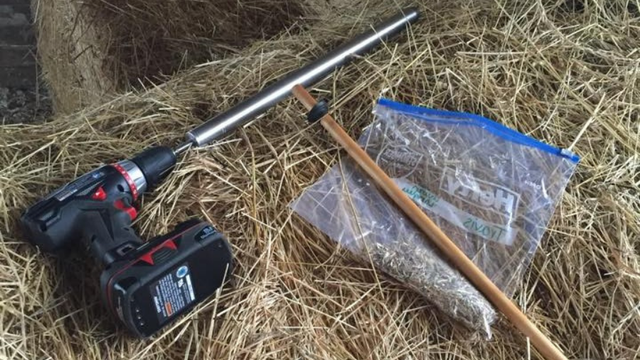
Accurate results begin with proper sampling. The best way to collect a representative hay sample is by using a hay probe to take core samples from multiple bales from the same lot of hay. These cores are then combined into one sample that represents the overall quality of that cutting or field.
Hand-grab samples from the outside of bales are often misleading because weathering and storage conditions can affect the outer layers differently than the inside of the bale.
To help producers collect accurate samples, our Extension office has a hay probe available for checkout. The probe attaches to a cordless drill and makes it easy to collect core samples from round or square bales. Using the probe helps ensure that the sample submitted to the lab accurately represents the hay that will be fed. If you'd like to use the hay probe, please call Abby at 828-255-5522.
A Small Investment with Big Returns
Hay testing is a simple, low-cost practice that can have a major impact on livestock nutrition and farm profitability. Knowing the quality of your forage allows you to develop a more strategic feeding program, improve animal performance, and make better use of the hay you already have on hand.
If you are interested in testing your hay, need help collecting a sample, or would like to check out the hay probe, contact the Extension office for assistance. We are happy to help producers interpret forage test results and use them to improve their feeding programs.