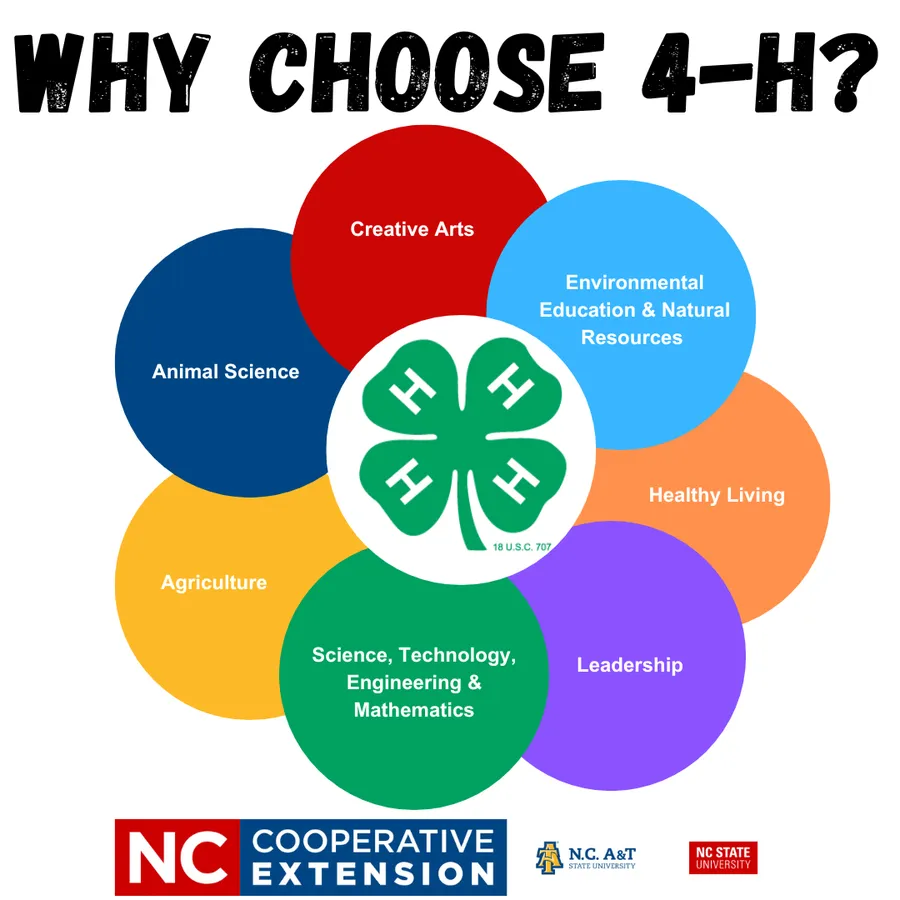
In today's society where there are countless numbers of programs for youth to be involved in, many families find they are faced with making decisions about which programs to have their children participate in.
So what makes 4-H different than other youth programs and why should your family be involved?
To answer this question, first let's take a look back at the history of 4-H!
(Source: National 4-H Council)
Late 1800's: Making Connections
Since 4‑H began more than 100 years ago, it has become the nation’s largest youth development organization. The 4‑H idea is simple: help young people and their families gain the skills needed to be proactive forces in their communities and develop ideas for a more innovative economy.
1902: Youth Clubs are formed
A. B. Graham started a youth program in Clark County, Ohio, in 1902, which is considered the birth of 4‑H in the United States. The first club was called “The Tomato Club” or the “Corn Growing Club”. T.A. Erickson of Douglas County, Minnesota, started local agricultural after-school clubs and fairs that same year. Jessie Field Shambaugh developed the clover pin with an H on each leaf in 1910, and by 1912 they were called 4‑H clubs.
1914: Cooperative Extension Program is Created
The passage of the Smith-Lever Act in 1914 created the Cooperative Extension System at USDA and nationalized 4‑H. By 1924, 4‑H clubs were formed and the clover emblem was adopted.
The Cooperative Extension System is a partnership of the National Institute of Food and Agriculture (NIFA) within the U.S. Department of Agriculture (USDA), more than 100 land-grant universities and more than 3,000 county offices across the nation. Cooperative Extension combines the expertise and resources of federal, state, and local governments and is designed to meet the need for research, knowledge and educational programs.
4-H Today
Today, 4‑H serves youth in rural, urban, and suburban communities in every state across the nation. 4‑H’ers are tackling the nation’s top issues, from global food security, climate change and sustainable energy to childhood obesity and food safety. 4‑H out-of-school programming, in-school enrichment programs, clubs and camps also offer a wide variety of STEM opportunities – from agricultural and animal sciences to rocketry, robotics, environmental protection and computer science – to improve the nation’s ability to compete in key scientific fields and take on the leading challenges of the 21st century.
So Why Choose 4-H?
4-H Provides youth with hands-on experiences which are rooted in research-based information. 4-H is the youth development program of Cooperative Extension – a community of more than 100 public universities and 3,000 local offices. Programs are delivered by more than 3,500 4‑H professionals and more than 500,000 volunteers.
4-H has a rich history of being a leader in positive youth development for more than a century. The tie with land- grant universities and the U.S. Department of Agriculture assures a research and science base to the program. Local, state, and national partners look to 4-H for advice in positive youth development.
4‑H’s hands-on approach is proven through extensive research to grow life skills like confidence, independence, resilience and compassion through stages and developed through experiences, not instruction.
The result? Kids who are empowered with the skills to lead for a lifetime.
What do youth DO in 4-H?
4-H Programs provide youth with experiences where they learn by doing, grow from failure, express their ideas and use their influence to drive positive outcomes. Adult mentors provide guidance, ask questions, share learnings and encourage.
In Buncombe County, we have a variety of different 4-H Clubs, Summer Programs, workshops, projects and more where youth can "learn by doing"!
Isn't 4-H just about animals and agriculture?
Although our roots are in agriculture, today 4-H provides opportunities for youth in so much more! Our core 4-H program areas are: STEM, Agriculture, Healthy Living and Civic Engagement.
Are you ready to get involved in 4-H? Explore the links below to learn how to start "learning by doing"!