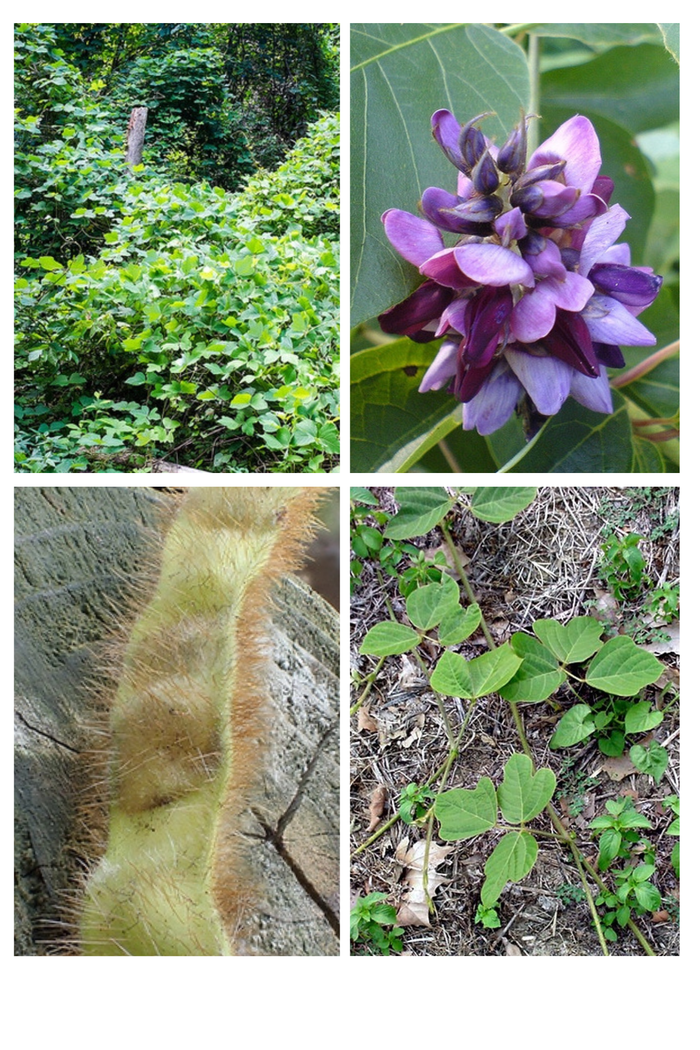
Pueraria montana (Kudzu)
Kudzu is one of the most notorious invasive plants present in WNC. Kudzu was originally brought to the U.S. primarily for its ornamental characteristics and ability to rapidly establish itself in loose soil. It is most commonly found in areas of high erosion and can be found in both urban, and rural areas throughout the southeastern U.S. Kudzu, similarly to other invasive plants, can quickly displace native plant populations with its woody vine habit smothering grasses, shrubs, and trees.
Identification
Kudzu is a perennial weed that colonizes quickly with monitored growth rates of up to a foot of growth per day during the active growing season! This vining plant can root from nodes that touch the ground surface with leaves that are alternate, trifoliately compound, and have an entire margin (no serrations along the outside of the leaves). Leaves get thicker as the season goes on with leaves and petioles that are hairy on younger portions of the plant with hairs declining as the plant ages. Flowers bloom in July with purple-reddish racemes that are 4-8” long. Root tubers can be massive with shoots forming adventitiously throughout the root system. Look for the characteristic trifoliate leaves and extensive vining habit as a key identifier for this weed.
Control
Kudzu can be controlled, usually through repeated efforts due to energy stored in tuber root systems requiring time and patience. Typically, the best strategy is to treat foliarly with a systemic herbicide (glyphosate, aminopyralid, dicamba, and triclopyr are the most common active ingredients recommended, with the best one determined by your particular situation). The cut stump method can work as well. Typically non-ionic surfactants are recommended to increase penetration into the cambial tissue of the roots. It is critical if foliar herbicide treatment is to be administered, that it be done early in the growing season when the vines are younger and actively growing. DO NOT wait too late in the year to spray! The cuticle on the outside of the leaf thickens throughout the summer, greatly reducing the herbicide effectiveness). Mowing is also a recommended treatment method as kudzu does not tolerate repeated mowing over time. Herd animals such as goats prove to be a strategy in reducing the coverage of kudzu populations.
It is important to note that kudzu can be near bodies of water, or in other environments that require a particular license to administer an aquatic formulation of herbicide. Always read the label to determine if surfactants are recommended, and what specific types of site the product can be used on.
There are no silver bullets in the control of tough invasive plants, but active and consistent management can lead to the reduction of populations over time. Kudzu is no different. It is important to start treatment before growth rates start to decline later in the summer. Be mindful of drift when using any herbicide product and always follow pesticide label directions! It is important to understand how to use a product safely, and where you can use that product. In certain areas, like aquatic sites, right-of-way, or forested areas, products have to be specifically listed for use in those areas in order to utilize an herbicide. If you have questions about product recommendations, or how to manage Kudzu, feel free to reach out to your local county Extension office for guidance. For more information about invasive weed management, visit our website and learn more as invasive plant BOLO’s are published.
Resources:
NC State Plant Toolbox- Kudzu
Kudzu factsheet- Mississippi State Extension
Invasive Plant Management: Forming a Gameplan After Helene- NC State Extension