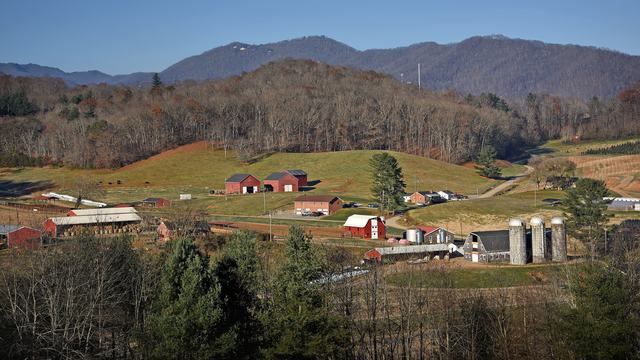
With 1,074 farms and 78,245 acres of farm land, Buncombe County serves as a powerful segment of North Carolina’s agricultural economy.
The USDA Census of Agriculture, conducted every five years, with the next being in 2027, is our state’s most comprehensive source of agricultural statistics. Since 1820, when US Marshals first rode horseback from homestead to homestead taking note of how the land was being worked, the public has recognized that accurate information is important for farming enterprises of all sizes. Today, that data is more important than ever for North Carolina and for Buncombe County.
Who Qualifies as a Farmer?
Many small farmers don’t know they qualify as a farm and miss their chance at being counted.
“Any farm, regardless of size, that sells, or would normally sell, $1,000 in ag products” can participate in the Ag Census, says Holly Jordan, Director of NC Cooperative Extension Buncombe County Center. “These can be traditional and rural farms or small urban plots as long as they meet that sales threshold.”
Buncombe County has a number of urban farms, hay farmers, mushroom growers, microgreen operations, and local honey producers that may be eligible to participate in the census if they do not already.
“It is important to have data that works to help improve lawmakers’ decisions about jobs, transportation, production practices, the Farm Bill, disaster money and rural community investment,” Jordan continues. Results from the census also track statistics regarding agricultural trends and identifying new markets – a blueprint for businesses looking to establish themselves or expand into Buncombe County.
What Does the Census Ask?
The census asks questions on the following topics:
Land & Acreage
- Physical footprint of your farming operation. Number of acres owned. Number of acres you rent from others or rent out to others.
- How that land is used - How many acres of cropland, pasture, woodland and land dedicated to farmsteads and buildings.
Crops & Production
- Field crops, fruits, berries, vegetables - Number of acres harvested and total yields.
- Nursery and Greenhouse operations - Square footage of greenhouses, acres of outdoor flowers, potted plants, bedding crops, etc.
- Whether any of your crops are certified organic.
Livestock & Poultry
- Headcount of cattle, hogs, sheep, goats
- Poultry - Number of broilers, layers, turkeys, ducks, quail
- Niche livestock such as bees - Number of colonies and honey production
- Aquaculture
Economics & Practices
- Gross Value of Sales - What bracket your total agricultural sales fall into.
- Operating Expenses - General estimates on what you spent on feed, seed, fertilizer, hired labor, utilities.
- Modern Practices - Whether your farm uses internet access for business, renewable energy such as solar panels, or precision agriculture technology.
Operator Demographics
- Age, gender, ethnicity, race
- Military veteran status
- Years of farming experience
- Whether farming is your primary occupation or if you work a separate off-farm job
2022 Information
What's At Stake
Numbers from the census play an instrumental role in determining federal funding allocated toward land conservation projects and preservation of agricultural land. One example is the Environmental Quality Incentives Program, also known as EQIP. This program assists farmers in implementing conservation practices such as improved livestock feeding equipment or planting cover crops to alleviate erosion and protect natural waterways. Funds for the EQIP program are allocated using USDA data that measures local agricultural density and resource needs.
North Carolina ranks second in the nation at losing farmland to development. Texas is currently losing more land than any other state. Tennessee, Georgia, and Ohio complete the top five. The USDA Agricultural Conservation Easement Program - Agricultural Land Easement (also known as the ACEP-ALE), provides funds to local land trusts instrumental in helping farmers preserve their land. These funds are determined by a point system with numbers from the Ag Census used as one component.
Our state legislature recently passed the 2026 State Budget which included a one time lump sum of $46.9 million dollars allocated directly to the Agricultural Development and Farmland Preservation Trust Fund on a state-wide level. An additional $2 million as a recurring supplement is dedicated to the cause in subsequent years. All farmers, regardless of the size of their operation, benefit from completing the Agricultural Census and ensuring their farming operation is counted.
Building Buncombe's Future
Buncombe County leadership has laid the foundation for a positive future regarding our local food system, open spaces and agricultural economy. Participating in the Ag Census lets public officials know where our farmers currently stand in their farming business careers and helps support the visibility of our county’s farmers when policy, funding and land-use decisions are made.
The following major plans currently outline the county’s goals for our current and future farmers:
Buncombe County 2043 Comprehensive Plan
Highlights of this plan include Buncombe County ensuring “that the county’s highest quality farmland and forestland will be conserved for the benefit of future generations.”¹ Other highlights include preserving land for agricultural-based education, promoting economic development opportunities that will capitalize on and strengthen our county’s agricultural sector, and utilizing grant funding opportunities through the USDA and North Carolina Department of Agriculture & Consumer Services (NCDA&CS).
Buncombe County 2030 Strategic Plan
One component of this plan is for the county to “increase economic viability and stability of agriculture by supporting 20 farmers with workshops, business planning, and farm estate planning by 2030.”²
Farmland can easily be lost when there is no successor or well developed plan for its future. With 769 farmers in Buncombe County over the age of 65, farm succession planning is vital for the future of local farming. Data like this, collected from the census, helps the county and its resources develop appropriate programming where needed.
Buncombe County’s 2020 Farmland Protection Plan is the most current plan for farmland preservation in our county. Many of the statistics used in this plan were taken directly from the 2017 Census of Agriculture.
How Can I Be Included in Future Surveys?
The census can be filled out online or by having a paper copy mailed to you.
If you have never received an invitation to complete the Ag Census survey or had a paper copy mailed to you and would like to participate, visit agcounts.usda.gov to sign up.
References:
- Buncombe County 2043 Comprehensive Plan.
Page 98
2. Buncombe County 2030 Strategic Plan.
Page 34